Recent Posts
Bauhaus and the Poster: Form Follows Persuasion
The Bauhaus had an ambivalent relationship with the poster. Founded by Walter Gropius in Dessau in 1919 with the intention of reconciling fine art and craft production, the school’s core pedagogical commitments — truth to materials, functional form, rejection of ornament — did not map cleanly onto a medium whose entire purpose is affective manipulation. A poster that tells the truth about its own conditions of production is not necessarily a poster that works.
read more
Collecting Vintage Travel Posters: What the Market Knows
The vintage travel poster market is old enough to have developed its own pathologies. What began as nostalgic accumulation in the 1970s — former railway employees, tourism board retirees, people who remembered the originals in context — has evolved into a structured secondary market with auction records, condition grading systems, and a small number of dealers who have spent decades building expertise the books don’t contain. Understanding what drives value in this market requires understanding both the history of the objects and the psychology of the people who want them.
read more
How to Frame and Display Posters: A Few Rules the Industry Won't Tell You
The framing industry has a structural incentive to complicate the process of protecting flat paper. Consultations, custom cuts, specialty glass, archival mat boards with competing certifications — by the time you have finished discussing options with a competent framer, you can easily spend three times the cost of the poster on the container. Some of that expenditure is justified. Most of it is not. Understanding which decisions actually matter, and which are elaborations on simpler principles, will save money and produce better results.
read more
Movie Poster Design: From the One-Sheet to the Algorithm
The theatrical one-sheet is 27 by 40 inches. That dimension has been standard since the early twentieth century, sized to fit the display cases outside cinema lobbies. It is one of the most constrained formats in commercial design — fixed proportions, fixed display context, fixed viewing distance — and within those constraints, some of the most inventive image-making of the past hundred years has happened. The current state of the form is less encouraging.
read more
Soviet Propaganda Posters: The Cold Logic of the Image
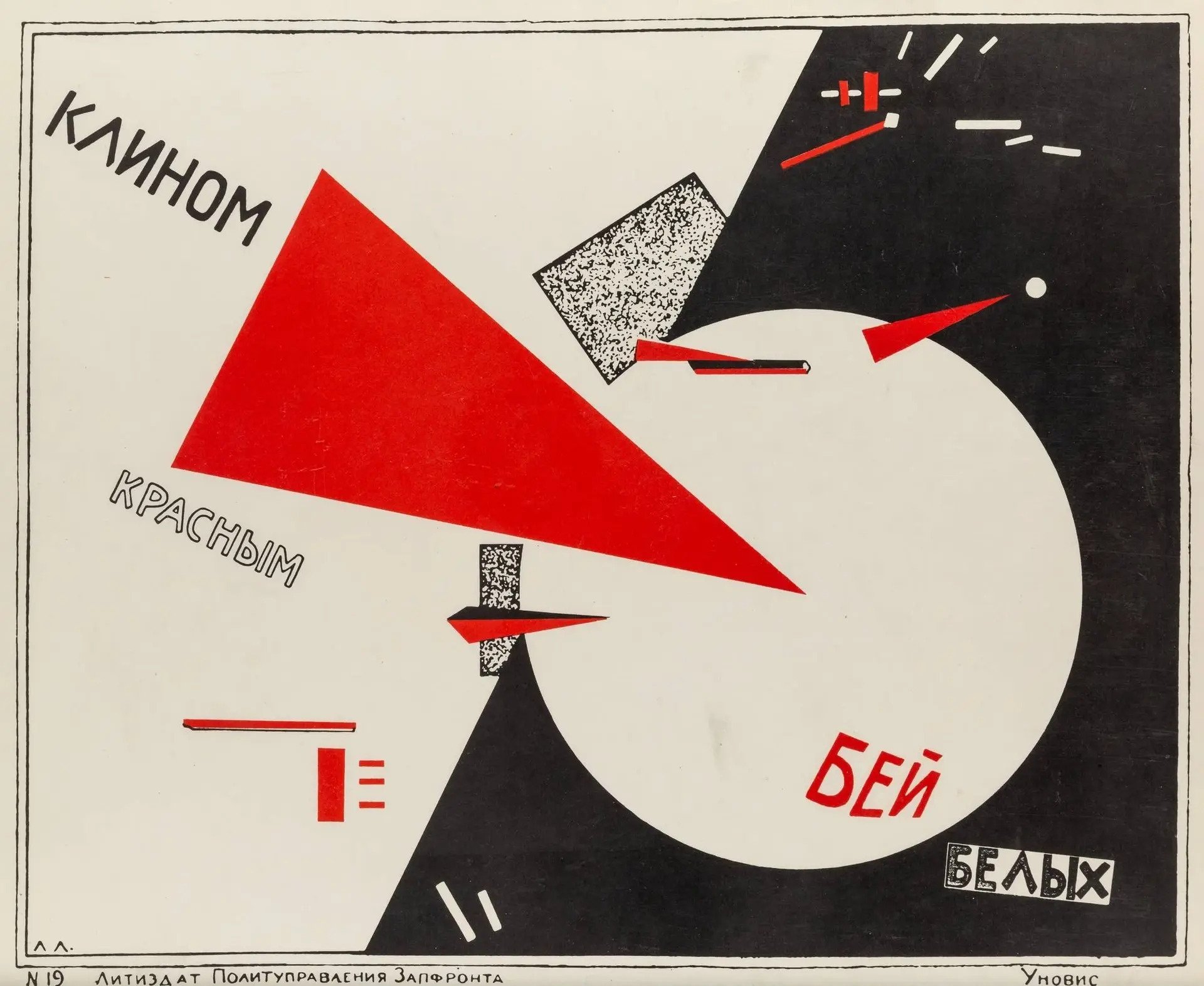
The Soviet propaganda poster is one of the most systematically studied artifacts of twentieth-century visual culture, and also one of the most misread. The tendency is to process it as historical curiosity — a relic of a failed state, interesting for what it tells us about ideology, less so for what it tells us about design. That reading is comfortable but wrong. The best work produced under Soviet auspices between 1917 and the mid-1930s represents a coherent, rigorous visual philosophy that solved real problems of mass communication under conditions of extreme constraint.
read more
Street Art and the Poster: Wheat Paste as Medium
The wheat-paste poster is the oldest form of outdoor advertising and one of the most persistent forms of unauthorized public communication. It requires nothing that cannot be purchased at a hardware store and a copy shop: paper, flour, water, and the willingness to apply the mixture to a surface you do not own in a jurisdiction that has probably criminalized the act. The simplicity of the materials is part of the point.
read more
The Lithograph and the Birth of the Modern Poster
Before lithography, the street was a typographer’s domain. Text-heavy broadsides announced executions, theater openings, and quack remedies in dense, undifferentiated blocks. Color was expensive, illustration was slow, and the idea of an image stopping a pedestrian in their tracks was largely theoretical. Alois Senefelder’s invention of lithography in 1796 changed the physics of what printing could do — but it took most of the nineteenth century for anyone to understand what that meant for public space.
read more
The Psychedelic Concert Poster: San Francisco, 1966–1971
Five designers. Five years. A body of work that constitutes one of the strangest and most consequential episodes in American poster history. Wes Wilson, Victor Moscoso, Alton Kelley, Stanley Mouse, and Bonnie MacLean — working largely for promoters Bill Graham at the Fillmore and Chet Helms at the Avalon Ballroom — developed a visual language so specific to its moment that it has never been successfully separated from it. Every subsequent attempt to use the style without the context reads as pastiche.
read more
The Swiss International Style and the Grid That Ate Design
The International Typographic Style, developed primarily in Zurich and Basel in the 1950s, is the most successful design movement of the twentieth century by any measure of influence. It conquered corporate identity, magazine layout, wayfinding systems, and poster design with a thoroughness that would be remarkable even if its formal prescriptions had been arbitrary — which they were not. The Swiss style solved real problems, and its solutions were good enough that they became defaults, and its defaults became invisible, and its invisibility is now so complete that most people cannot see the infrastructure it built.
read more
Wartime Poster Design in World War II: The State as Art Director
Every major combatant in the Second World War produced poster campaigns at industrial scale, and the differences between national approaches illuminate something real about how each state understood its relationship to its citizens. American wartime poster production was extensive, formally diverse, and institutionally chaotic. British production was more controlled and, at its best, more artistically coherent. German and Soviet production operated under tighter ideological constraints and achieved, in different ways, a formal intensity that democratic production rarely matched.
read more