Shogun Roads Reimagined in a Single Frame
The poster unfolds like a layered memory rather than a simple scene, almost as if time itself has been folded and pressed into one vertical composition. At the very top, a sweeping illustrated landscape stretches outward beneath soft pink cherry blossoms, with Mount Fuji rising in the distance—calm, immovable, almost symbolic of continuity. Below it, rivers snake through valleys and settlements, tracing the logic of movement that once defined the Edo period. You can almost follow those routes with your eyes, imagining travelers drifting from one province to another, carried by obligation, trade, or curiosity.
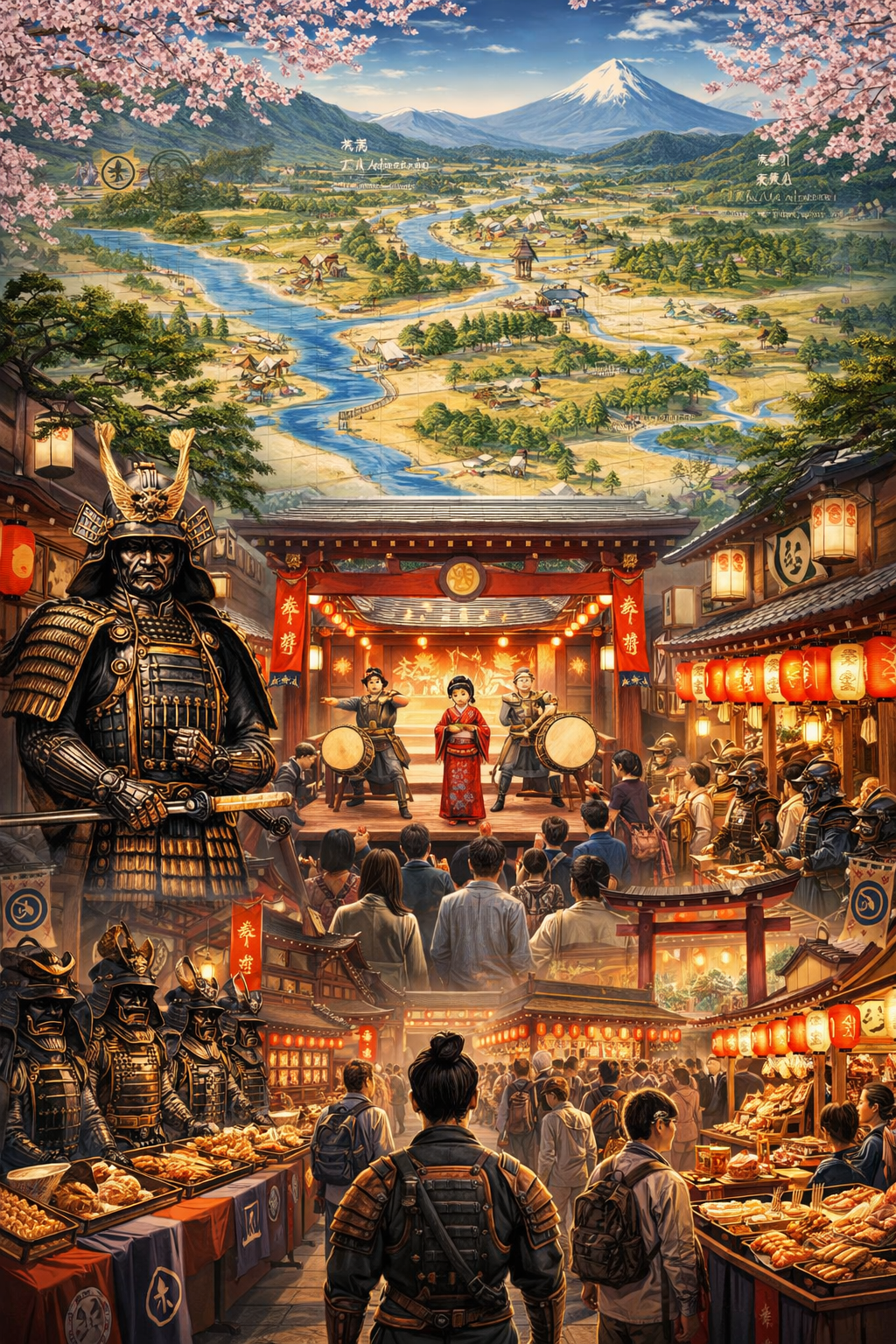
Edo Shogun Roads Fest Experience & Gourmet, March 20, 2026, Tokyo Midtown Yaesu
Then the scene shifts, and it does so abruptly but intentionally. The calm geography gives way to density—wooden structures, lanterns glowing in warm amber tones, and a central stage framed like a shrine. Performers stand in traditional attire, frozen mid-performance, while the crowd gathers tightly in front of them. It feels staged, but not artificial—more like a reenactment that has grown into something living again. The lighting changes here too, becoming warmer, more intimate, almost pulling you into the moment whether you want to or not.
And then there’s the presence of the shogun—less a single figure, more an atmosphere. On the left side, a towering armored warrior stands almost like a guardian of the composition, his armor detailed and heavy, with gold accents catching the light. He doesn’t interact with the crowd; he watches. Around him, other samurai figures appear—some static, some integrated into the festival environment—blurring the line between history and performance. It’s not entirely clear where the past ends and the present begins, and that ambiguity feels intentional.
Lower down, the poster becomes crowded, almost overwhelming in the best way. Food stalls line both sides, each glowing under rows of lanterns, their colors shifting between deep reds and soft golds. The textures stand out here—grilled food, lacquered wood, fabric patterns—everything rendered in a way that makes the scene feel tactile. Visitors move through the space, modern clothing mixed subtly with traditional elements, creating this strange, seamless coexistence of eras.
What makes the composition work is how it never fully settles into one identity. It isn’t purely historical, and it isn’t fully contemporary. Instead, it builds a narrative of continuity—roads that once connected Edo to the rest of Japan now reappear as cultural pathways, guiding people not just physically but visually through the frame. The upper map-like landscape suggests direction and scale, while the lower festival compresses that journey into a single, dense experience.
There’s also a quiet sense—well, maybe not quiet, more like underlying—that this isn’t just about nostalgia. The poster feels constructed to suggest movement outward. You start at the center, in the festival, then your eye drifts upward, following rivers and roads, eventually reaching the horizon. It subtly nudges you to think beyond the scene itself, toward the idea of traveling those routes in reality.
It ends up being less of a poster and more of an invitation disguised as an image. Not explicit, not instructional, just… suggestive. And that might be why it works so well.