Canaletto Framed This Rialto View First and Every Phone Still Copies It
Stand on the San Marco side of the Grand Canal, put the Rialto Bridge in the middle distance, let the palace fronts run away on both sides, and you have made a picture that was commercially standardised nearly three hundred years ago. The composition is not a discovery. It is an inheritance.
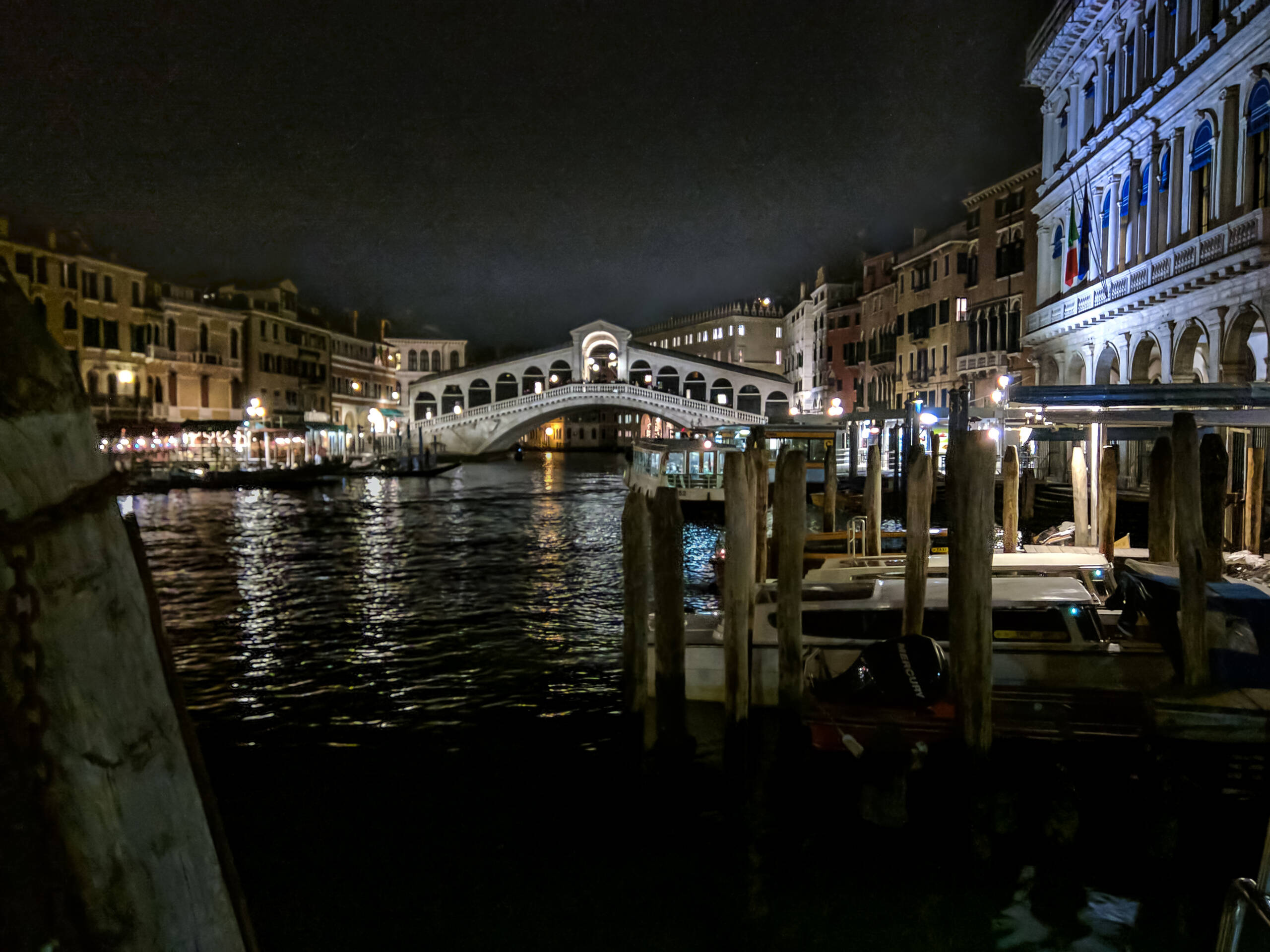
The veduta, the topographical city view, became a Venetian export industry in the first half of the eighteenth century. Luca Carlevarijs established the format, Canaletto industrialised it, and Francesco Guardi ran it into a looser, more atmospheric register once the market had matured. These were not private meditations on a beloved city. They were souvenirs sold to foreign visitors on the Grand Tour, mostly British, who wanted proof of where they had been and something handsome to hang at home.
That market had a broker. Joseph Smith, an English merchant resident in Venice who later became consul, acted as Canaletto’s agent and effectively productised him: a stable of recognisable viewpoints, consistent handling, repeatable output at a known price. Buyers were not commissioning a unique vision. They were choosing from a catalogue of views, and the Rialto from the water was near the top of it.
The consequences for how the city gets photographed today are direct. A handful of vantage points were selected because they were legible, saleable, and repeatable, and those points hardened into the canonical set. The bridge from downstream. The Salute from the Riva. The Piazza looking towards the basilica. Anyone arriving with a camera walks into a frame that was optimised for a customer base that died in the eighteenth century.
There is a technical inheritance too. Canaletto almost certainly used a camera obscura for parts of his working process, and the wide, slightly stretched perspective in many of his views carries the signature of an optical device rather than an unaided eye. The modern phone lens does something similar at the edges. Two different tools, roughly two and a half centuries apart, imposing a comparable geometry on the same stretch of water.
What the eighteenth century did not sell was the night. Candle and oil light could not carry a topographical view, so the veduta market ran on daylight and, at its most theatrical, on festival scenes lit by fireworks. Nocturnal Venice as a saleable image is a product of gas, then electricity, then sensors capable of recording what the eye can barely resolve. It is the one part of this frame that has no eighteenth-century original to be measured against.
Which suggests where the interest actually lies now. Reproducing the canonical daylight view is a solved problem and the solution is already hanging in Windsor, the Wallace Collection, and half the country houses of England. The view under artificial light, with the water broken and the sky empty, is the version the market never standardised.