Atlas, Prometheus, and the Mural That Was Chiseled Off the Wall: Rockefeller Center's Art Program
Nobody standing in the plaza in December is looking at the sculpture. They are looking at a tree, and behind it a limestone slab that goes up further than the phone can frame. But the block they are standing on holds the most ambitious coordinated art commission ever attempted on a private American site, executed by roughly thirty artists working to a single written program, and it has never really been repeated.
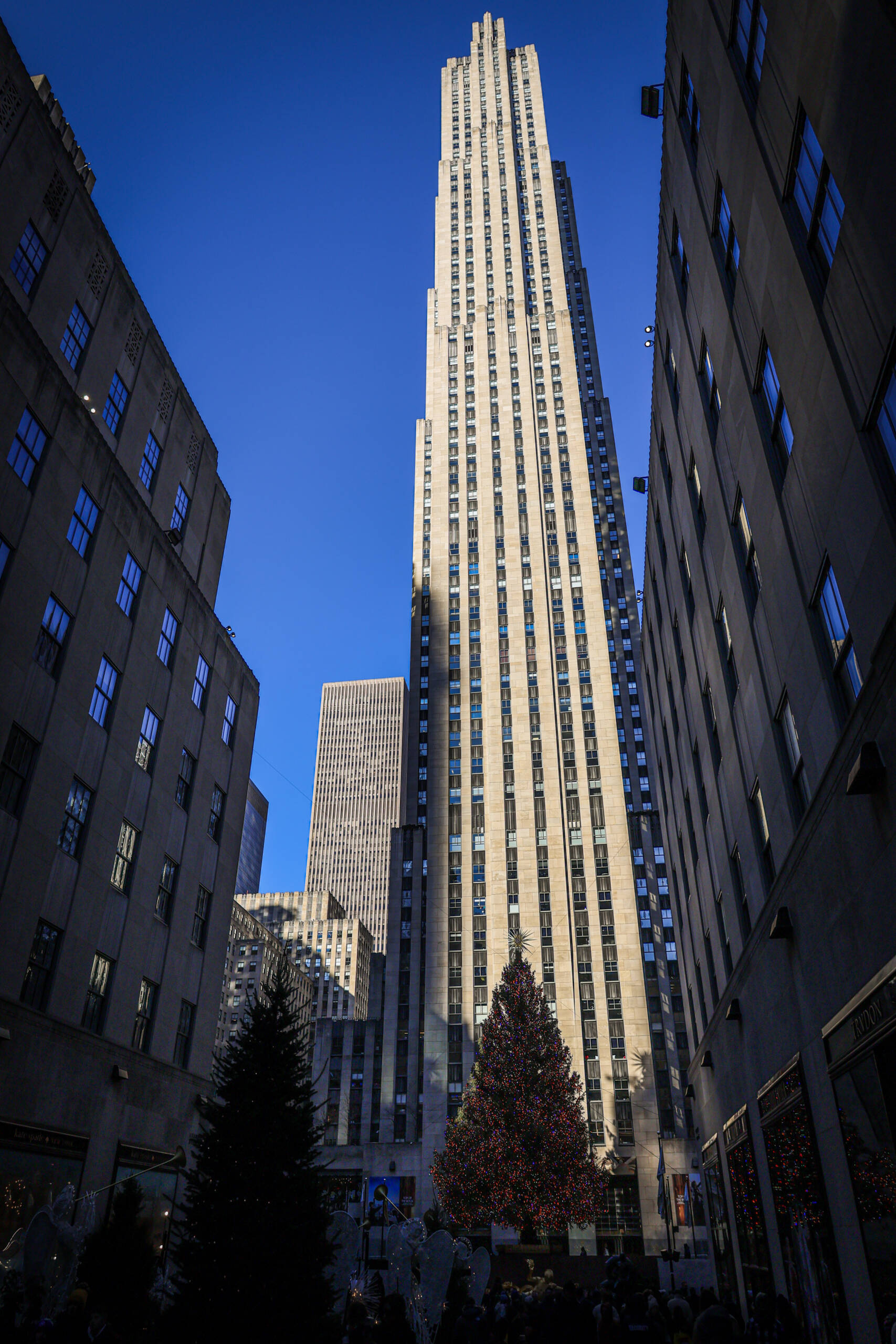
The program was drafted by Hartley Burr Alexander, a philosophy professor brought in to give the complex a governing theme rather than a shopping list of decorations. What he produced was a single sprawling subject: man at the crossroads, looking uncertainly but hopefully toward the future. Every commission was supposed to answer to it. Sculpture, murals, mosaics, glass and metalwork were assigned to artists who were told what the building meant before they were told what to make. Alexander eventually fell out with the developers over exactly how literally the scheme should be enforced, which tells you the scheme was real enough to fight about.
Lawrie and Manship
Lee Lawrie got the two best positions and made the most of both.
Over the main entrance on the plaza he set Wisdom, a bearded figure leaning out of the limestone with a compass, drawing the boundaries of the world below, mounted above a cast glass screen that turns the whole panel into something between relief carving and stained glass. It is polychrome, which people forget, because it reads as stone from across the street. The inscription is from Isaiah, and it is doing real work: wisdom and knowledge as the stability of the age. On a building financed by the largest private fortune in America during the worst year of the Depression, that is not a neutral statement.
Around the corner on Fifth Avenue, Lawrie and René Chambellan set Atlas on the forecourt of the International Building. A bronze titan holding the armillary sphere over his head, on a pedestal that puts the whole thing well above street level and squares it directly with St Patrick’s Cathedral across the avenue. Some people saw Mussolini in the face when it went up in 1937, and the accusation has never entirely gone away. Whether or not Lawrie intended it, the figure is muscular in the exact register that the decade had made politically legible.
Paul Manship’s Prometheus sits at the bottom of the sunken plaza in gilded bronze, ringed by the fire quotation from Aeschylus. It is the most photographed object in the complex and the most frequently dismissed by critics, who find it decorative where Lawrie is architectural. That is a fair reading of the object and an unfair reading of the site. Manship was solving a problem nobody else on the project had: the plaza is a hole in the ground that people look down into, so the sculpture had to work as a plan, a silhouette, and a background for a restaurant. Gilding it was the correct answer to a space that spends most of the day in shadow.
The Mural
Then there is the wall in the lobby of 30 Rockefeller Plaza that has a Sert on it, and shouldn’t.
Matisse turned the commission down. Picasso would not engage. Diego Rivera got it, with support from Abby Aldrich Rockefeller, who collected him and who had rather better instincts about modern art than the men running the project. He was given the theme, he was given the wall, and he painted Man at the Crossroads: industry and science on one side, capital and war on the other, and in the middle, unmistakably, a portrait of Lenin joining the hands of workers.
The sketches had not included the head. Rivera was asked to remove it. He offered to balance it by adding Lincoln instead, which was not the concession anyone was looking for. He was paid his full fee, removed from the site in May 1933, and the mural was covered. In February 1934 it was chiselled off the wall and destroyed.
Rivera repainted it in Mexico City later that year, at the Palacio de Bellas Artes, under a new title and with a few pointed additions including a portrait of Rockefeller Jr. in a nightclub scene. The New York wall got a Josep Maria Sert instead, an allegory of American progress in muted sepia that does everything it is asked to do and asks nothing of anyone.
The destruction is usually filed as a censorship story. It is also an argument about what integrated commissions actually are. Alexander’s program was coherent because someone had authority over meaning. Rivera tested where that authority ended and found out.
Why It Did Not Happen Again
You can push back on the claim in the title. The federal art programs of the later 1930s employed vastly more artists and covered vastly more wall. Postwar corporate patronage put serious work in serious lobbies. Percent-for-art ordinances have funded thousands of installations since.
The difference is subordination. Almost everything since has been art placed in a building. Rockefeller Center was art commissioned to a written argument, with the architecture, the iconography and the sculpture answering to the same document, at a scale of twenty-two acres. That requires a client willing to impose a meaning on a city block and to defend it, which is precisely the thing that makes the Rivera episode ugly and the complex coherent. You do not get one without the other.
The tourists are not wrong to photograph the tree. It is the only part of the program that still gets renewed annually.