Lorenzo Quinn's Support in Venice: The Biennale Said No and the Photographs Said Yes
Two white hands come up out of the Grand Canal at night, lit hard from above, with the moored gondolas under their blue covers sitting between them and the camera. The palazzo behind is doing what Venetian palazzi do at that hour, which is glow. Nobody in the frame. Just the hands, the boats, the water shivering the lights back at you.
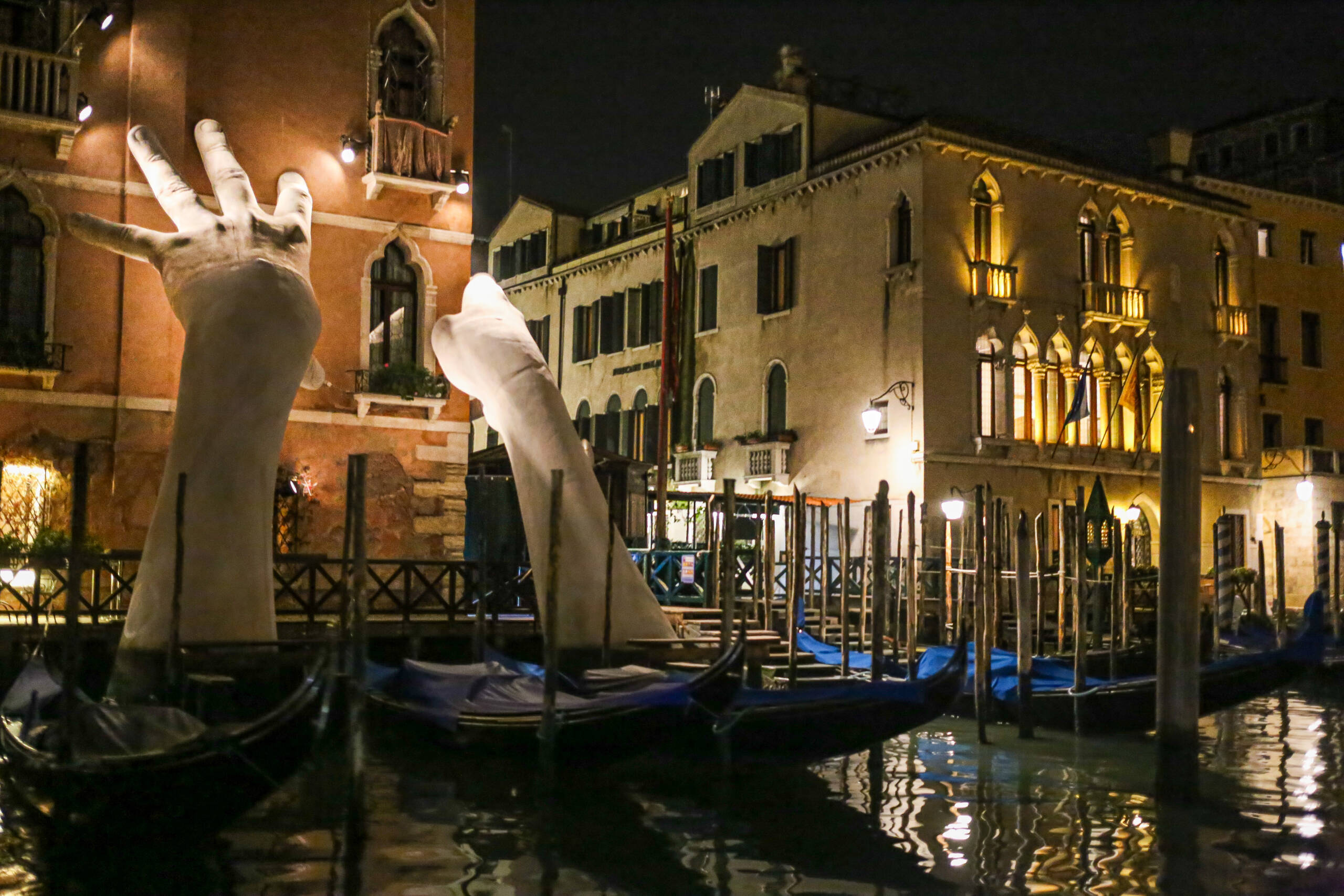
The piece is Lorenzo Quinn’s Support, installed against the corner of Ca’ Sagredo in May 2017 and left up until late November. Two hands about nine metres tall, modelled on his son’s, made to read as marble from a distance. They brace the fourteenth-century wall of the palace, and the point everyone took from them was climate: a city with water at its throat, held up by human hands that could as easily push it under.
The colossal hand has form
Detached giant hands are one of the older shortcuts in Western sculpture, and they work because a hand at that scale stops being anatomy and becomes agency.
In the courtyard of the Palazzo dei Conservatori in Rome, the surviving fragments of the colossal Constantine sit around a wall: the head, a foot, and a hand with one finger raised. The emperor is gone. The hand still commands the courtyard. Michelangelo built the most reproduced image in the Sistine Chapel out of two hands and the gap between them, which is the whole argument of the fresco compressed into about a foot of plaster. Rodin spent years on hands as independent objects, most famously the one holding a lump of clay with two figures half emerged from it.
Quinn is working inside that tradition and he is not being subtle about it. The Venetians skipped the title and just called them the hands.
The rejection is the interesting part
Support was not in the Biennale. Quinn has said the Biennale turned the proposal down, and that he read the refusal as a verdict on where he sits relative to the professional art world rather than on the work. It went up anyway, with backing from a commercial gallery, the city, and the hotel whose wall it was gripping.
Then it became the thing everyone came home with a picture of.
That is a genuinely awkward outcome for anyone who wants curatorial selection to mean something, and it is worth sitting with rather than sneering at. Two systems were running at once that season. One decides what belongs in the exhibition. The other decides what gets photographed, shared, and remembered, and it does not consult the first one. A work can lose the first vote by a mile and win the second so completely that people assume it was the centrepiece.
Built for the picture
Look again at how this thing is lit after dark. Spotlights from above, the white surface pulled up out of a black canal, everything else in the frame reduced to warm smears. That is not incidental. A sculpture on a waterway that thousands of people pass on boats, in the age of the phone camera, is designed knowing that most of its audience will meet it as an image rather than an object.
Which is where the older critique lands. Work that photographs this well tends to be work with one idea in it, delivered in full at first glance, with nothing much left for the second look. Support gives you everything it has in about a second and a half.
The counter-argument is standing right there in the water. A second and a half, multiplied by a few million people who would never have walked into the Arsenale, is not nothing.