Him, Her: A Photograph That Works Like a Renaissance Diptych
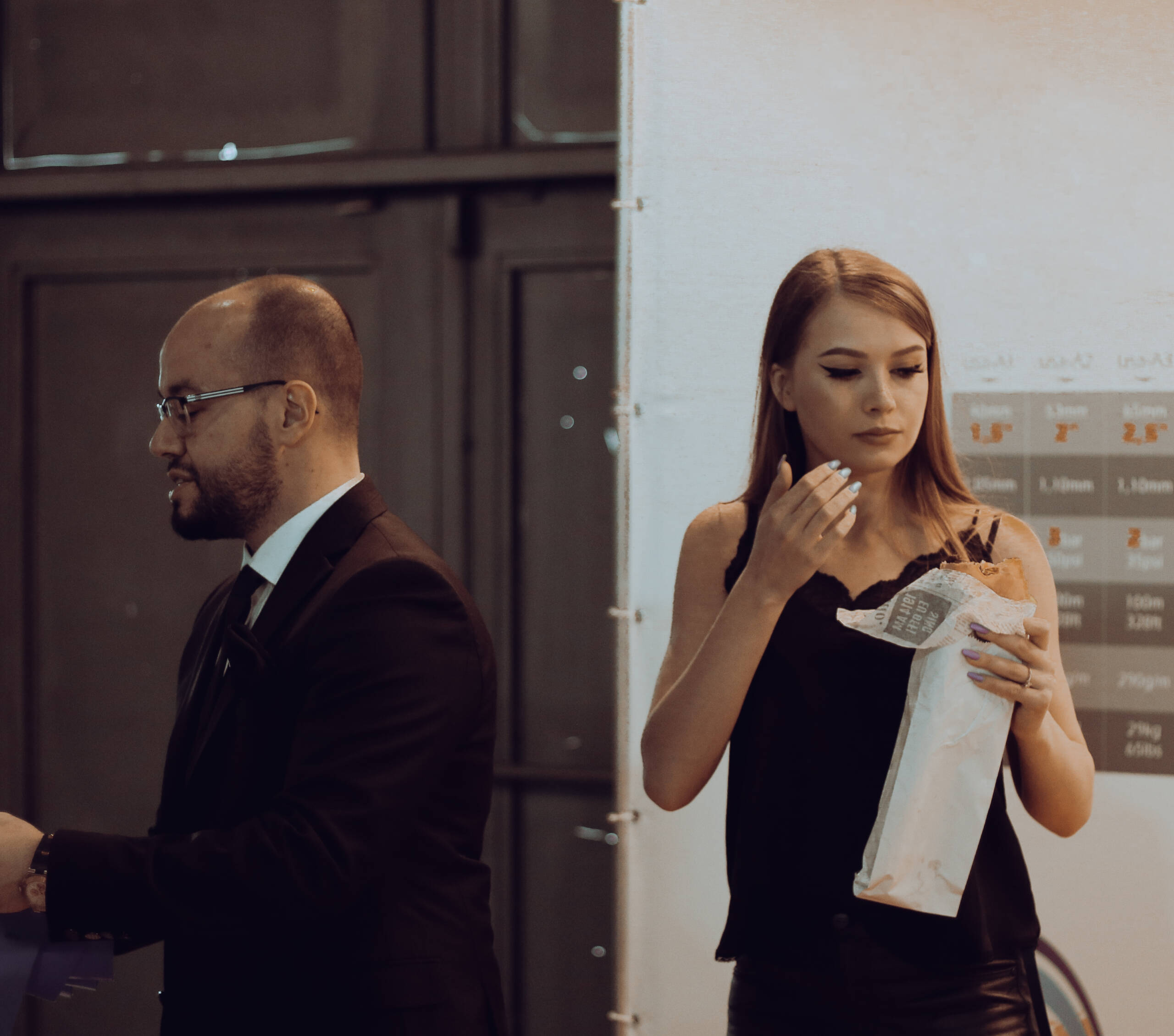
Two figures share a photograph and refuse to share anything else. He stands on the left in a black suit, glasses, mid-sentence, addressing someone outside the frame. She stands on the right in a black slip dress, eating from a paper wrapper, eyes down. Running between them is the white vertical edge of a display panel, and that edge does more work than either sitter.
The hinge that isn’t there
Devotional painting spent three centuries solving this exact problem. A diptych gave you two panels and one hinge. The donor knelt on one wing, the Virgin sat on the other, and the two never occupied the same painted room. What bound them was carpentry. The frame asserted a relationship that the picture space denied, and viewers accepted the claim without argument.
Piero della Francesca pushed it further with the Urbino portraits. Federico and Battista face each other across a physical gap, profiles locked, landscapes continuous behind them. The gap is the subject. Remove it and you have two ordinary portraits.
The photograph borrows the whole apparatus. The panel edge is the hinge, painted white and lit brighter than anything else in the frame. It splits the image close to the golden section rather than the middle, which is why the composition reads as deliberate rather than accidental. Two panels, one board.
Attributes, assigned as usual
Diptych sitters came with attributes. A book, a rosary, a coat of arms, a hound. The objects announced what kind of person you were looking at before you read the face.
Here the assignment is clean. He gets the suit, the tie, the glasses, a watch just visible at the wrist, a hand extended toward business happening off-frame. She gets a crumpled paper wrapper, painted nails, one hand raised to her mouth. Formal attribute against everyday attribute. The picture does not editorialise about which is which, and the refusal to editorialise is what keeps it from being a joke.
Behind her, a specification chart in the background glows in orange and grey. Millimetres, weights, thicknesses. It sits exactly where a gold ground or a landscape window would sit in the painted version, and it performs the same function, telling you what world these people belong to.
Facing away
The tradition mostly had sitters face each other. Turning them away is a later move, and it belongs to the nineteenth and twentieth centuries. Degas put couples in the same interior with no sightline between them. Hopper made a career of two people in one room and two separate weathers. The device stopped meaning marriage and started meaning proximity without contact.
That is the register this photograph lands in. They are not a couple. They are probably not colleagues. They are two people standing at the same event, and the frame has proposed a pairing that neither of them agreed to. The title makes the proposal explicit and then declines to explain it.
The sepia treatment matters more than it looks. Warm monochrome flattens the skin tones, the black clothing, the brown lockers, and the white panel into one tonal family. Colour would have separated the two halves into separate pictures. The tone stitches them back together, which is the only thing in the image doing any stitching at all.
What the frame can and cannot claim
A diptych claims a relationship it cannot demonstrate. So does this photograph. Both rely on the viewer to close a gap that the picture leaves deliberately open, and the closing happens fast, before you have decided whether you agreed to do it.
She looks away. He keeps talking. The hinge holds.